

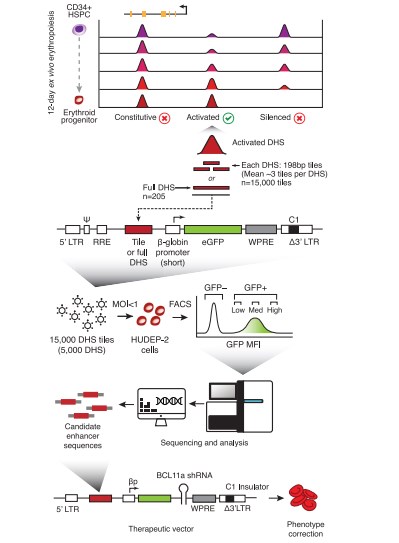
A large research group led by Dr. Jeff Vierstra, a researcher at the Altius Institute for Biomedical Sciences in Seattle (USA), and Dr. Nikoletta Psatha, Assistant Professor in the Department of Biology at Aristotle University of Thessaloniki (Greece), developed an one-shot approach for screening candidate regulatory sequences from large-scale epigenomics data for programmable transgene expression within vectors designed for gene therapy. Their research was published in Nature Communications.
As gene expression during cell development and differentiation is regulated by distal regulatory elements that precisely modulate gene activity based on the cell type, gene therapy vectors exploit these elements for spatial- and temporal-specific transgene expression.
A library of 15,000 short sequences derived from developmentally active elements during erythropoiesis was evaluated using a clinically relevant reporter vector. These elements display a gradient of enhancer transcriptional activity in erythroid cells, with high specificity in both cell type and developmental stage.
Finally, replacing the canonical β-globin μLCR regulatory sequence with a compact enhancer introduced into a lentiviral vector for β-thalassemia successfully corrects the thalassemic phenotype in patient-derived hematopoietic stem and progenitor cells (HSPCs), while increasing viral titers and the cells’ ability to take up exogenous genetic material (cell transducibility). This approach may provide further insights into enhancer biology with broader implications for human gene therapy.